
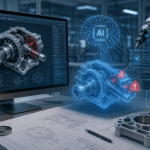

In modern manufacturing and product development, even a small drafting error can lead to production delays, material waste, compliance issues, or costly redesigns. As engineering projects become more complex, mechanical drafting teams are increasingly turning to Artificial Intelligence (AI) to detect design flaws before manufacturing begins.
From automated clash detection to predictive tolerance analysis, AI is reshaping how engineering teams approach quality control in CAD workflows. Today, companies using advanced mechanical CAD design services are leveraging intelligent systems to improve accuracy, reduce manual review time, and accelerate product delivery.
According to McKinsey & Company, AI adoption in engineering and industrial operations continues to rise as manufacturers seek faster design cycles and fewer production-stage errors. Meanwhile, reports from Autodesk Research suggest that AI-assisted design tools can significantly reduce repetitive drafting tasks and improve engineering efficiency.
So how exactly are mechanical drafting teams using AI in real-world workflows? And what does this mean for manufacturers, architects, startups, and engineering firms across the USA and UK?
Let’s explore.
Why Are Design Errors So Expensive in Mechanical Manufacturing?
Mechanical drafting errors often remain hidden until fabrication or assembly begins. At that stage, the consequences become expensive.
A simple issue such as:
- Incorrect dimensions
- Misaligned components
- Tolerance conflicts
- Missing annotations
- Assembly interference
- Material mismatches
can disrupt the entire manufacturing process.
According to The American Society of Mechanical Engineers (ASME), engineering errors detected during production can cost exponentially more than issues identified during the design stage.
This is why businesses increasingly invest in intelligent mechanical design and drafting services that combine CAD expertise with AI-powered validation tools.
How Is AI Transforming Mechanical Drafting Workflows?
AI is no longer limited to automation in factories. It is now deeply integrated into CAD software and drafting environments.
Modern AI-enabled drafting systems can:
- Detect geometry inconsistencies
- Predict assembly clashes
- Validate tolerances
- Identify missing dimensions
- Recommend optimized component layouts
- Analyze manufacturability risks
- Compare designs against historical project data
Platforms from companies like Autodesk Fusion, SolidWorks, and Siemens Digital Industries Software are increasingly integrating AI-driven features into mechanical drafting and product development workflows.
For drafting teams, this means fewer manual checks and faster error detection before production files are released.
What Types of Design Errors Can AI Detect Before Production?
One of the biggest advantages of AI in drafting is its ability to identify hidden issues that human reviewers may overlook.
1. Assembly Interference and Clash Detection
AI-powered CAD systems can instantly detect when components overlap or interfere with moving parts.
For example:
- Gear clearance issues
- Pipe routing conflicts
- Fastener alignment problems
- Rotational movement restrictions
Instead of waiting for physical prototyping, drafting teams can resolve these conflicts during the digital design phase.
This capability has become especially valuable in industries such as:
- Automotive
- Aerospace
- Industrial machinery
- HVAC engineering
- Manufacturing equipment design
2. Tolerance Stack-Up Analysis
Tolerance-related failures are among the most common production problems in mechanical engineering.
AI tools can automatically analyze:
- Dimensional accumulation
- Assembly fit
- Manufacturing variability
- Precision risks
This allows engineers providing mechanical product design services to optimize tolerances before production begins.
As products become more compact and precision-driven, AI-assisted tolerance analysis is becoming critical for modern manufacturing.
3. Missing Dimensions and Annotation Errors
Manual drafting reviews often miss incomplete annotations or inconsistent dimensioning standards.
AI can automatically flag:
- Missing GD&T symbols
- Incomplete callouts
- Incorrect units
- Layer inconsistencies
- Duplicate dimensions
This improves drawing quality while supporting industry compliance standards such as ASME Y14.5 and ISO drafting regulations.
4. Manufacturability Issues
Some CAD designs look correct digitally but become difficult or expensive to manufacture.
AI-driven Design for Manufacturing (DFM) analysis can identify:
- Sharp internal corners
- Tool accessibility issues
- Excessive machining complexity
- Unsupported structures
- Material inefficiencies
This is helping companies reduce production costs while improving product feasibility.
Why Are UK and USA Engineering Firms Investing in AI-Based Drafting?
Engineering firms in the UK and USA face increasing pressure to deliver projects faster while maintaining precision and compliance.
Several market trends are accelerating AI adoption:
Rising Product Complexity
Mechanical assemblies today include:
- Multi-material components
- Embedded electronics
- Precision machining
- Lightweight structures
- Smart manufacturing integration
AI helps drafting teams manage this growing complexity more efficiently.
Skilled Labor Shortages
According to Deloitte Insights, manufacturing and engineering industries continue to face skilled workforce shortages globally.
AI helps reduce repetitive drafting workloads so experienced engineers can focus on innovation and critical decision-making.
Faster Product Development Cycles
Startups and manufacturers increasingly demand rapid prototyping and faster product launches.
AI-assisted mechanical CAD design services allow drafting teams to:
- Reduce revision cycles
- Improve collaboration
- Accelerate approval processes
- Minimize production rework
This provides a competitive advantage in highly demanding industries.
How Does AI Improve Mechanical 2D Drafting Services?
While 3D modeling often receives the most attention, AI is also transforming mechanical 2D drafting services.
Intelligent drafting systems can now:
- Convert 3D models into automated 2D shop drawings
- Maintain drawing consistency
- Auto-generate BOMs (Bill of Materials)
- Standardize templates
- Validate annotations
- Detect drafting standard violations
For manufacturers still relying heavily on fabrication drawings, AI-powered 2D drafting significantly improves speed and accuracy.
This is particularly important in industries where shop-floor documentation remains essential for production workflows.
Can AI Replace Mechanical Drafting Professionals?
No and this is one of the biggest misconceptions.
AI is not replacing mechanical drafting teams. Instead, it is becoming a collaborative engineering assistant.
Human expertise remains essential for:
- Engineering judgment
- Product innovation
- Design intent
- Industry compliance
- Functional decision-making
- Client communication
AI simply enhances productivity by automating repetitive validation and analysis tasks.
The most successful engineering firms are combining experienced drafting professionals with AI-assisted workflows rather than replacing human talent altogether.
What Are the Biggest Challenges of AI in Mechanical Drafting?
Although AI offers major advantages, implementation still comes with challenges.
Data Quality Issues
AI systems rely on high-quality CAD data and historical project information. Poor drafting standards can reduce AI effectiveness.
Software Integration Complexity
Many companies still use older CAD environments that may not fully support modern AI tools.
Integration across:
- PLM systems
- ERP platforms
- CAD software
- Manufacturing systems
can require significant planning.
Training and Adoption
Engineering teams often need training to effectively use AI-driven drafting features.
Some professionals initially resist automation due to concerns about workflow disruption or job security.
However, organizations investing in training typically achieve stronger long-term adoption and productivity gains.
What Does the Future of AI in Mechanical CAD Design Look Like?
The next generation of AI-driven CAD systems is expected to become even more advanced.
Emerging trends include:
Generative Mechanical Design
AI can automatically generate optimized component geometries based on performance goals.
This approach is already being used in aerospace, automotive, and industrial engineering sectors.
Real-Time Simulation Feedback
Future CAD platforms may provide live manufacturability and stress analysis during drafting itself.
Instead of separate validation stages, engineers could receive instant design optimization suggestions.
AI-Powered Collaboration
Cloud-based drafting platforms are enabling real-time collaboration between:
- Engineers
- Manufacturers
- Architects
- Product designers
- Suppliers
AI will further streamline communication and version control across distributed teams.
How Can Businesses Benefit from AI-Enhanced Mechanical CAD Design Services?
Businesses adopting AI-supported drafting workflows can achieve measurable operational improvements.
Potential benefits include:
- Reduced production errors
- Faster product development
- Lower manufacturing costs
- Improved compliance accuracy
- Shorter revision cycles
- Better collaboration
- Increased design consistency
For startups and manufacturers, these efficiencies can directly impact profitability and time-to-market performance.
Final Thoughts
AI is rapidly transforming how mechanical drafting teams detect and prevent design errors before production begins. From tolerance analysis to manufacturability validation, intelligent CAD workflows are helping engineering firms improve quality, reduce waste, and accelerate innovation.
As industries across the UK, USA, and global manufacturing markets continue to embrace digital transformation, AI-enhanced mechanical design and drafting services will become increasingly important for maintaining competitive advantage.
Businesses seeking scalable and future-ready engineering support are now prioritizing partners that combine traditional drafting expertise with modern AI-assisted CAD technologies.
Companies such as Shalin Designs and other leading UK CAD engineering providers are already exploring advanced workflows that integrate automation, intelligent drafting systems, and precision-focused design strategies for modern manufacturing environments.