
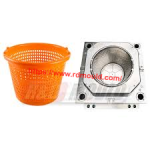

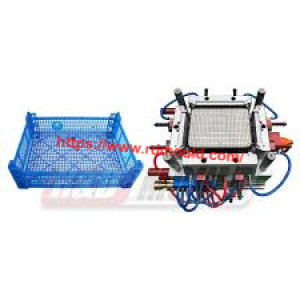
Injection moulding professionals constantly seek ways to shorten cycle times without sacrificing part quality. The cooling phase consumes the largest portion of each cycle, making efficient heat removal a primary target for productivity gains. A Basket Mould from rdmould incorporates conventional cooling channels drilled in straight lines, yet these linear passages cannot follow the curved contours typical of basket geometries. This limitation creates uneven cooling, prolonging cycle times and risking warpage. Conformal cooling channels, which follow the part shape, promise uniform temperature distribution and shorter cycles. Does a Basket Mould truly achieve faster cycle times through conformal cooling, or do the manufacturing complexities outweigh the benefits?
Examine the thermal dynamics of a typical basket geometry. Deep-drawn shapes with varying wall thicknesses and complex handle features create areas where heat concentrates. Conventional straight cooling lines run through the core and cavity blocks, maintaining set distances from the cavity surface. These fixed distances cannot accommodate the varying contour of a basket design, leaving some sections overcooled and others undercooled. Rdmould's conformal cooling approach uses additive manufacturing or specialized machining to create channels that mimic the basket's curvature. RuiDing's engineering team maps the heat distribution across the entire Household Mould surface, positioning cooling lines precisely where thermal extraction needs are greatest.
The cycle time reduction from conformal cooling stems from two mechanisms. First, uniform cooling eliminates the need for extended cooling time to allow the hottest sections to reach ejection temperature. Second, balanced cooling reduces warpage, minimizing the need for post-mould straightening or secondary operations. A mould with conformal channels can achieve dimensional stability earlier in the cooling cycle, allowing earlier ejection. Rdmould's data from production trials indicates that conformal cooling typically shortens total cycle time by a measurable margin compared to conventional drilling. RuiDing's design process includes thermal simulation that predicts cycle time savings before any metal is cut, enabling evidence-based decisions.
Cooling channel placement determines the effectiveness of conformal designs. The channel cross-section, spacing from the cavity wall, and hydraulic diameter all influence heat transfer rates. For a basket design, the handle regions and base corners present the greatest cooling challenges. Rdmould positions conformal channels closer to these critical areas than conventional drilling permits, accelerating heat extraction where it matters most. RuiDing's manufacturing capabilities include 3D printing of mould inserts with intricate internal networks that cannot be produced through conventional machining. This technological capability opens design possibilities that were previously impractical for Household Mould production.
Manufacturing complexity remains the primary barrier to conformal cooling adoption. Creating curved internal passages requires specialized equipment, increasing mould fabrication time and cost. A mould with conformal cooling from rdmould typically costs more than a conventionally cooled equivalent. RuiDing's cost analysis weighs this initial expense against the lifetime productivity gains. When production volumes are high, the reduced cycle time per shot accumulates into significant annual output increases, offsetting the higher mould cost. Lower-volume applications may not justify the additional investment, making volume a critical selection factor.
Maintenance considerations affect the practical viability of conformal cooling. Straight drilled channels allow simple cleaning with standard tools, while conformal passages may trap debris or scale. Rdmould designs conformal channels with smooth transitions and adequate access ports, facilitating maintenance access. RuiDing's material selection includes corrosion-resistant alloys that reduce scale formation, preserving cooling efficiency over the mould's service life. A mould with conformal cooling requires cleaning protocols that match the channel complexity, a factor that moulders must include in their operational planning.
Cooling circuit layout influences the uniformity achievable with conformal designs. The inlet and outlet positions, channel sequence, and flow rate all affect the temperature gradient across the cavity. Rdmould employs computational fluid dynamics to optimize these parameters, ensuring that each basket mould receives cooling water at the right temperature and flow rate. RuiDing's thermal engineers balance the cooling demands of different basket features, using varying channel diameters to adjust heat extraction locally. This sophisticated design produces a Household Mould that maintains the cavity temperature within narrow limits, producing consistent parts regardless of ambient conditions.
Material selection for the mould itself interacts with conformal cooling effectiveness. Tool steels with high thermal conductivity transfer heat faster, amplifying the benefit of conformal channels. Rdmould recommends specific steel grades that balance wear resistance and thermal properties for basket mould applications. RuiDing's material experts evaluate the anticipated production volume and the required surface finish, selecting steels that maximize the return on conformal cooling investment. The combination of proper steel selection and conformal channel design produces a cooling system that extracts heat as fast as the plastic's thermal properties permit.
Process stability improves with conformal cooling beyond cycle time reduction. A mould that experiences thermal cycling within a narrow range produces parts with consistent dimensions, reducing scrap rates. Rdmould's customers report fewer rejections for warpage and dimensional non-conformance after switching to conformal designs. RuiDing's after-sales support includes ongoing monitoring of cooling system performance, helping users maintain the efficiency of their Household Mould over years of service. This reliability translates to predictable production schedules and lower operating costs.
The economic case for conformal cooling depends on production volume, part complexity, and material type. A basket mould for a simple design with low production requirements may not achieve a quick return on the higher mould cost. Rdmould assists customers in calculating the break-even point, considering all relevant factors. RuiDing's transparent pricing includes detailed comparisons between conventional and conformal options, enabling informed decisions. The true value emerges in high-volume production where every second of cycle time saved contributes directly to profit.
Looking at the broader moulding operation, conformal cooling affects more than just the injection cycle. Uniform part quality reduces downstream finishing work, and consistent dimensions simplify assembly operations. Rdmould engineers consider the entire production workflow when designing a Household Mould, not just the injection phase. https://www.shinemold.com/product showcases moulds designed with these comprehensive efficiency goals. RuiDing's holistic approach to mould design ensures that cooling improvements produce benefits throughout the manufacturing process, from raw material to finished goods. With the right design, conformal cooling transforms a standard Household Mould into a high-performance production tool. A Basket Mould engineered with conformal cooling from rdmould delivers the thermal balance needed for consistent, rapid production. Does your current cooling strategy maximize your production capacity, or does it leave potential output untapped?