


Market overview
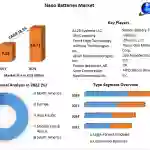
The Nano Batteries Market was valued at approximately USD 7.22 billion in 2022 and is projected to reach USD 23.71 billion by 2029, expanding at a CAGR of 18.5% during 2023–2029, according to Maximize Market Research.Nano batteries are gaining attention because they can provide faster charging, longer operating life, wider operating-temperature ranges and improved performance compared with conventional battery technologies. Rising demand for smartphones, laptops, connected devices, electric vehicles (EVs), industrial backup systems and other battery-powered equipment is creating a strong addressable market.
The rapid electrification of transportation is expected to remain one of the most important long-term opportunities. EV manufacturers require batteries capable of delivering higher energy density, rapid charging, improved safety and longer cycle life. Nano-engineered materials, including silicon-based anodes, nanoporous structures and advanced lithium-ion chemistries, can help manufacturers address these requirements. At the same time, increasing digitalization and the proliferation of portable electronics are raising demand for compact batteries that can store more energy without substantially increasing device size. Investment in next-generation battery materials and manufacturing infrastructure is therefore expected to create opportunities for nano battery developers, material suppliers and cell manufacturers. The MMR report identifies transportation as a high-potential application while noting that consumer electronics currently dominates application demand.
U.S. Market Trends and Investment in 2025
The United States strengthened its focus on advanced battery manufacturing and domestic supply chains during 2025. In January 2025, the U.S. Department of Energy announced its intention to provide up to USD 725 million to support domestic production of battery critical materials, components and advanced batteries. DOE also announced an up to USD 8 million funding opportunity in January 2025 aimed at improving the manufacturability and pre-production design of energy-storage technologies, helping promising technologies progress toward commercial-scale manufacturing.
A particularly important development for nano-enabled battery materials was Sila's commissioning of its Moses Lake, Washington, silicon-anode manufacturing plant in April 2025. The facility was designed to produce Sila's Titan Silicon material at automotive scale, with production scheduled to begin in the second half of 2025. These investments demonstrate increasing U.S. interest in silicon and other advanced electrode materials that can improve battery energy density and charging performance.
Request To Free Sample of This Strategic Report ➤ https://www.maximizemarketresearch.com/request-sample/15283/
Market Segmentation: Largest-Share Segments
By Application: Consumer Electronics held the dominant position in the global nano batteries market. The growing use of smartphones, tablets, laptops, wearable electronics and other portable connected devices is increasing demand for compact, high-performance and rapidly rechargeable batteries.
By Type: Customized Batteries dominated the market. Demand for customized battery formats is supported by the diverse power requirements of laptops, wireless power tools and other electronic devices where battery size, shape, charging speed and performance must be optimized for individual applications.
By Region: Europe held the highest market share in 2022 according to the MMR report. The region's established automotive industry, increasing EV adoption and emphasis on battery manufacturing and energy-transition technologies support its position in the market.
Competitive Analysis
The competitive landscape includes established battery manufacturers, advanced-material companies and technology developers. The MMR report identifies A123 Systems LLC, 3M Company, Front Edge Technology, mPhase Technologies Inc., Altair Nanotechnologies Inc., Evonik Industries AG, Sony Corporation, Toshiba, Nano One Materials Corp., Sila Nanotechnologies Inc. and 6K, among others, as key industry participants. Because the publicly available MMR page does not disclose individual company market-share percentages, the following companies should be regarded as leading/key participants rather than as a verified numerical ranking by share.
Sila Nanotechnologies Inc. is a major advanced-material innovator focused on silicon-carbon anode technology. In September 2025, Sila announced that its Moses Lake facility had begun operations and was preparing initial batches of Titan Silicon for applications including EVs, consumer electronics, drones, AR/VR and satellites. The plant initially supports 2–5 GWh of capacity and was designed with potential expansion to 250 GWh.
Toshiba Corporation continued advancing its SCiB battery platform in 2025. The company introduced a new SCiB lithium-ion module for electric buses, electric ships and stationary applications, emphasizing heat dissipation, rapid charging and high-load operation. Toshiba also began offering paid samples of its SCiB™Nb battery using a niobium titanium oxide anode, targeting ultra-fast charging and long cycle life.
3M Company remains a significant advanced-materials participant listed by MMR, with its materials-science capabilities relevant to electrodes, separators, coatings and battery manufacturing technologies. Its broad technology portfolio positions the company to participate in the development of higher-performance battery components.
A123 Systems LLC is another established battery technology company identified in the MMR competitive landscape. Its focus on lithium-ion battery systems and high-power applications supports opportunities created by transportation electrification and advanced energy-storage requirements.
Nano One Materials Corp. is included among MMR's key players and focuses on advanced battery-material technologies. The development of scalable, cost-effective and lower-impact methods for producing battery cathode materials can contribute to the wider commercialization of next-generation batteries.
Regional Analysis
United States: The U.S. market is benefiting from government efforts to establish domestic battery-material and manufacturing capacity. Federal funding initiatives in 2025 targeted critical materials, advanced batteries and manufacturing technologies, creating an increasingly supportive environment for next-generation battery technologies.
Germany: Germany remains an important European market because of its large automotive manufacturing base and continued transition toward electric mobility. Demand for advanced batteries is supported by the need for higher range, faster charging and improved vehicle performance.
France: France's emphasis on clean transportation and industrial decarbonization supports opportunities for advanced battery technologies. EV development and European battery supply-chain initiatives can encourage demand for high-performance battery materials.
UK: The United Kingdom provides opportunities through its automotive, electronics and energy-storage industries. The need for domestic and resilient battery supply chains supports research and commercialization of advanced battery materials.
Japan: Japan has strong expertise in electronics, automotive technologies and battery research. Companies such as Toshiba and Sony contribute to the development of advanced battery technologies, while demand from consumer electronics and mobility applications creates additional opportunities.
China: China remains a major force in the global battery and EV ecosystem. MMR notes that China produces around 70% of electric vehicles, while the broader Asian battery supply chain provides an important foundation for advanced battery deployment.
Request To Free Sample of This Strategic Report ➤ https://www.maximizemarketresearch.com/request-sample/15283/
Key Players
-
A123 Systems LLC
-
3M Company
-
Front Edge Technology
-
mPhase Technologies Inc.
-
Altair Nanotechnologies Inc.
-
Evonik Industries AG
-
Sony Corporation
-
Toshiba
-
Nano One Materials Corp.
-
Sila Nanotechnologies Inc.
-
6K
-
ZPower, LLC
-
HPQ Silicon Resources Inc.
-
FaradPower, Inc.
Conclusion
The global nano batteries market is positioned for substantial expansion as demand shifts toward batteries offering higher energy density, faster charging, longer life and improved safety. The projected rise from USD 7.22 billion in 2022 to USD 23.71 billion by 2029, at an 18.5% CAGR, illustrates the commercial potential of the technology. In our view, the most important growth opportunity will come from the convergence of EV adoption, consumer-electronics miniaturization and investment in advanced materials such as silicon-based anodes and nanoparticle-enabled battery structures. U.S. investments in domestic manufacturing and companies scaling silicon-anode production demonstrate that the industry is moving beyond laboratory research toward commercial deployment. As manufacturing costs decline and performance improves, nano batteries could become an increasingly important technology across transportation, electronics, industrial power and emerging energy-storage applications.
About Maximize Market Research
Maximize Market Research Pvt. Ltd. (MMR) is a global market research and consulting company that provides reliable, data-focused, and practical business insights. The firm serves a wide range of industries, including healthcare, pharmaceuticals, technology, automotive, electronics, chemicals, personal care, and consumer goods. Through market forecasts, competitive analysis, strategic consulting, and industry impact assessments, MMR helps organizations understand changing market conditions, identify growth opportunities, and make informed business decisions for long-term success.
Contact Us
Maximize Market Research Pvt. Ltd.
2nd Floor, Navale IT Park Phase 3
Pune Banglore Highway, Narhe
Pune, Maharashtra 411041, India
Phone: +91 9607365656
Email: sales@maximizemarketresearch.com