
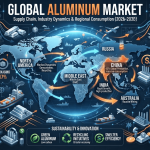





Discover aluminum market opportunities as electric mobility, infrastructure development, recycling, advanced manufacturing, and sustainability reshape future demand.
The Global aluminum market is entering a strategically important phase as industries worldwide seek materials that combine lightweight performance, durability, versatility, conductivity, and recyclability. According to 6Wresearch, the market was valued at USD 175 billion in 2024 and is projected to reach USD 240 billion by 2031, expanding at a CAGR of 4.60% during 2025–2031. Transportation, construction, packaging, aerospace, electrical systems, and industrial manufacturing remain major demand centers, while electric vehicles, recycling, and sustainable production are creating new opportunities.
Advantages of Investing in the Global Aluminum Market
The Global aluminum market offers strategic investment potential because aluminum supports a diverse collection of industries. Unlike materials dependent on one dominant application, aluminum demand comes from transportation, construction, packaging, aerospace, electrical infrastructure, machinery, consumer products, and emerging technologies.
This diversified demand base creates opportunities across the value chain. Companies can participate in primary production, processing, fabrication, recycling, alloy development, and specialized component manufacturing.
Transportation represents one of the most promising areas. Automakers and aerospace manufacturers are increasingly focused on lightweighting while maintaining safety, durability, and performance. Aluminum can be incorporated into vehicle structures, body components, wheels, aircraft parts, rail systems, and other engineered applications.
Electric mobility adds another major opportunity. EV manufacturers are seeking lightweight materials to improve efficiency and driving range. Aluminum can be used in structural components, wheels, battery-related applications, and thermal-management systems.
Recycling is also becoming strategically important. Because aluminum can be recycled repeatedly while retaining its fundamental properties, investment in collection, processing, and secondary production can support both economic and sustainability objectives.
Why People Prefer Aluminum for Future Growth
Aluminum's combination of low weight, durability, corrosion resistance, conductivity, flexibility, and recyclability makes it attractive for long-term industrial applications.
In automotive manufacturing, aluminum can support lightweight vehicle designs. In aerospace, weight reduction can improve aircraft efficiency and performance. Construction companies use aluminum in windows, doors, façades, roofing, structural components, and architectural systems.
Packaging represents another major application. Aluminum cans, foil, containers, and related products provide protection and convenience while offering strong recycling potential.
As manufacturers increasingly look for materials that balance performance, efficiency, and environmental considerations, aluminum's characteristics can strengthen its position. This creates a solid foundation for future demand across the Global aluminum market.
Search Visibility Through Global Aluminum Market Opportunities
The expanding Global aluminum market is also creating greater competition among producers, processors, suppliers, recyclers, and technology companies. Businesses need effective ways to communicate their capabilities to industrial customers and procurement teams.
Industrial buyers often research alloy specifications, product quality, certifications, manufacturing capabilities, sustainability credentials, and supplier reliability before making purchasing decisions.
Companies that publish technically useful and relevant information can improve their search visibility and reach potential customers. This can be especially valuable for businesses operating in recycled aluminum, low-carbon production, advanced alloys, specialized extrusions, and electric vehicle components.
Strong digital visibility can complement technical expertise by demonstrating knowledge and making complex product information easier for buyers to evaluate. It can also help international suppliers reach new geographic markets.
Demand and Benefits Across Major Industries
The Global aluminum market benefits from broad demand across several important industries. Transportation, construction, packaging, aerospace, electrical engineering, machinery, and consumer products all contribute to consumption.
Transportation remains a major demand driver as manufacturers pursue lightweighting and improved efficiency. Aluminum can be used across automobiles, aircraft, rail vehicles, and other transportation systems.
Construction provides another significant opportunity. Aluminum's durability, corrosion resistance, flexibility, and visual appeal make it suitable for both functional and architectural applications.
Electrical infrastructure can support additional demand because aluminum provides useful conductivity while remaining relatively lightweight. It can therefore be used in power transmission and other electrical systems.
Packaging, aerospace, industrial machinery, and consumer products further diversify consumption. This broad application base provides resilience and supports long-term Global aluminum market expansion.
Enhance User Experience with Innovative Aluminum Solutions
Aluminum can enhance product functionality by combining lightweight construction with durability and design flexibility. Products made with aluminum can be easier to transport, install, handle, and operate while maintaining long-term performance.
Advances in extrusion, casting, rolling, forming, machining, and alloy development are expanding the range of possible applications. Manufacturers can develop aluminum products based on specific requirements for strength, weight, thermal performance, corrosion resistance, and appearance.
Electric vehicles can incorporate aluminum into lightweight structures and thermal-management applications. Consumer electronics can use aluminum for durable and modern designs, while buildings can use aluminum systems for flexible architectural solutions.
These developments are gradually shifting the Global aluminum market toward higher-value engineered and application-specific products.
Lifestyle Benefits from Expanding Aluminum Applications
Aluminum is already part of everyday life through automobiles, buildings, packaging, appliances, electronics, cookware, furniture, and electrical products.
Its lightweight characteristics can make products easier to move and handle, while durability can support longer service life. Corrosion resistance also makes aluminum useful for products exposed to moisture and changing environmental conditions.
Sustainability is becoming increasingly important to consumers and businesses. Aluminum's recyclability provides an advantage because recovered material can be returned to manufacturing rather than being discarded.
As recycling systems improve and circular economy practices become more widespread, aluminum could become even more important in sustainable product development.
Infrastructure Development Creates Strategic Opportunities
Infrastructure development is a major contributor to Global aluminum market growth. Urbanization, industrialization, population growth, and economic expansion are increasing investment in residential buildings, commercial facilities, airports, transportation networks, industrial plants, and electrical infrastructure.
Aluminum can be used in façades, windows, doors, roofing, structural products, electrical systems, transportation components, and architectural applications.
Asia remains an important production and consumption region because of its manufacturing base and infrastructure activity. Continued development in emerging economies can generate additional demand as cities, transportation networks, industrial facilities, and energy systems expand.
The Middle East and Africa are also developing industrial and infrastructure projects, while North America and Europe are focusing on infrastructure modernization, energy efficiency, recycling, and sustainable manufacturing.
These regional differences create opportunities for companies that can adapt their products, technologies, and supply chains to local market needs.
Sustainability Strengthens Future Market Potential
Sustainability is increasingly shaping the Global aluminum market. Aluminum's recyclability supports circular economy initiatives, while producers are exploring ways to reduce emissions and energy consumption.
Low-carbon aluminum, renewable energy integration, energy-efficient manufacturing, and increased recycled content are becoming more important throughout the value chain.
Automotive, construction, packaging, and other industries are increasingly evaluating the environmental characteristics of materials used in their supply chains. This creates opportunities for producers capable of supplying responsibly produced and lower-carbon aluminum.
The transition requires investment in cleaner energy, modern production systems, recycling infrastructure, and operational improvements. Companies will need to balance environmental progress with production costs and market competitiveness.
Technology and Advanced Materials Open New Opportunities
Technology and research are expanding aluminum's potential across the Global aluminum market. Advanced alloy development can improve strength, durability, thermal performance, corrosion resistance, and processing characteristics.
These improvements can support applications in aerospace, automotive manufacturing, electric vehicles, electronics, machinery, and other technically demanding industries.
Manufacturing innovation can also improve precision, consistency, productivity, and customization. As customers increasingly demand application-specific materials, research and development capabilities may become an important competitive advantage.
The future market is therefore likely to include a growing range of specialized alloys, engineered components, precision processing, advanced recycling technologies, and application-specific solutions.
Global Aluminum Market Forecast and Future Outlook
The Global aluminum market has a positive long-term outlook supported by several structural growth drivers. According to 6Wresearch, the market is projected to grow from USD 175 billion in 2024 to USD 240 billion by 2031, registering a CAGR of 4.60% during 2025–2031.
Future demand is expected to benefit from transportation lightweighting, electric mobility, construction, infrastructure development, packaging, aerospace, electrical systems, recycling, and sustainable manufacturing.
However, market participants will need to manage energy costs, raw material price volatility, geopolitical uncertainty, trade policies, environmental regulations, and supply-chain disruptions.
Companies that invest in efficient production, advanced technologies, recycling capabilities, sustainable processes, and resilient supply networks could be better positioned to capture future opportunities.
Wrapping Up
The Global aluminum market has strong long-term potential because aluminum serves industries that are central to economic development and technological innovation. Transportation, electric mobility, construction, infrastructure, packaging, aerospace, electrical engineering, and advanced manufacturing are creating multiple pathways for future demand.
The projected increase from USD 175 billion in 2024 to USD 240 billion by 2031 highlights the market's attractive growth potential. Emerging opportunities in recycled aluminum, low-carbon production, advanced alloys, EV components, and specialized manufacturing could further strengthen industry prospects.
Investors and businesses should carefully evaluate energy costs, raw material volatility, geopolitical risks, environmental requirements, trade conditions, and supply-chain challenges. Nevertheless, aluminum's diversified demand base, recyclability, and importance to future technologies provide strong underlying fundamentals.
For companies and investors seeking long-term industrial opportunities, buying or establishing a position in promising aluminum segments now could be a smart strategic decision. Early investment in electric mobility, infrastructure, recycling, advanced materials, and sustainable production may help businesses capture value as the Global aluminum market continues to expand.
FAQs
1. What are the major growth opportunities in the Global aluminum market?
Major opportunities include electric vehicle components, transportation lightweighting, infrastructure projects, advanced alloys, recycling, low-carbon production, specialized extrusions, and precision manufacturing. These areas can generate new demand while strengthening the long-term position of the Global aluminum market across established and emerging industries.
2. What is the Global aluminum market forecast through 2031?
According to 6Wresearch, the Global aluminum market was valued at USD 175 billion in 2024 and is projected to reach USD 240 billion by 2031. The market is expected to expand at a CAGR of 4.60% during 2025–2031, supported by diversified applications.
3. Why is aluminum important for electric vehicles?
Aluminum can help reduce vehicle weight while providing useful strength and durability. It can be used in structures, wheels, battery-related components, and thermal-management systems. Increasing EV production is therefore expected to create additional demand and opportunities within the Global aluminum market.
4. How does recycling support aluminum market opportunities?
Aluminum can be recycled repeatedly while retaining its fundamental properties. Recycling supports resource efficiency, reduces waste, and strengthens circular economy strategies. Investments in collection, processing, and secondary production can therefore create new opportunities throughout the Global aluminum market.
5. Which industries contribute most to aluminum demand?
Transportation, construction, packaging, aerospace, electrical engineering, machinery, consumer products, and infrastructure are major demand sectors. Emerging areas such as electric mobility, renewable-energy infrastructure, sustainable packaging, and advanced manufacturing can further strengthen demand across the Global aluminum market.
6. What are the best areas for aluminum-related investment?
Potential areas include recycling, advanced alloys, downstream processing, low-carbon production, specialized components, precision manufacturing, and EV applications. Companies supplying transportation, construction, aerospace, infrastructure, packaging, and electrical industries may also benefit from continued Global aluminum market expansion.
7. How does infrastructure development influence aluminum demand?
Aluminum is used in façades, windows, doors, roofing, structural products, electrical systems, transportation components, and architectural applications. Continued urbanization and infrastructure investment can therefore create sustained demand and strengthen growth opportunities across the Global aluminum market.
8. How is sustainability changing the aluminum industry?
Sustainability is encouraging greater use of recycled aluminum, renewable energy, energy-efficient production, and low-carbon manufacturing. As customers increasingly evaluate environmental performance across supply chains, producers with sustainable capabilities can gain opportunities and competitive advantages within the Global aluminum market.
9. What challenges could affect the aluminum market forecast?
Energy costs, raw material price volatility, geopolitical uncertainty, trade restrictions, environmental regulations, and supply-chain disruptions can affect market performance. Companies may need to improve efficiency, diversify sourcing, strengthen recycling capabilities, and adopt advanced technologies to manage risks.
10. Why could investing in aluminum be a strategic decision?
The Global aluminum market benefits from diversified demand across electric mobility, transportation, construction, infrastructure, packaging, aerospace, electrical systems, and recycling. While investors should assess market risks carefully, strategic exposure to high-growth applications and sustainable technologies could offer attractive long-term opportunities.
Read more..
Global adhesive tapes market
Global air traffic control market