
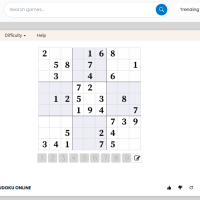
Sudoku is one of the most popular number puzzles in the world. Millions of people enjoy Sudoku every day because it combines entertainment, concentration, and logical thinking. Unlike many puzzle games that depend on luck, Sudoku relies entirely on reasoning and deduction. Every completed grid represents a successful exercise in problem-solving skills.
The simple design of Sudoku makes it accessible to players of all ages. A standard puzzle contains a 9x9 grid divided into nine smaller 3x3 sections. The objective is straightforward: fill every empty cell with numbers from 1 to 9 while following specific rules. Despite this simple concept, Sudoku can offer endless challenges ranging from beginner-friendly puzzles to extremely difficult brain teasers.
As digital gaming continues to grow, Sudoku remains relevant because it provides a unique mental workout. Whether played on paper, mobile devices, or online platforms, Sudoku continues to attract puzzle enthusiasts around the globe.
Understanding the Basic Rules of Sudoku
Before exploring advanced strategies, it is important to understand the core rules that define every Sudoku puzzle.
The Structure of the Grid
A traditional Sudoku puzzle consists of 81 cells arranged in nine rows and nine columns. These cells are further organized into nine smaller 3x3 boxes. Some cells already contain numbers, while others remain empty for players to complete.
Every puzzle starts with a partially filled grid. The number of pre-filled cells varies depending on the difficulty level.
Three Essential Rules
Every Sudoku puzzle follows three simple rules:
Each row must contain the numbers 1 through 9 exactly once.
Each column must contain the numbers 1 through 9 exactly once.
Each 3x3 box must contain the numbers 1 through 9 exactly once.
Following these rules allows players to gradually eliminate possibilities and identify correct placements.
Why Sudoku Remains Popular Worldwide
Sudoku has maintained global popularity for decades because it offers much more than simple entertainment.
A Powerful Brain Exercise
Many people use Sudoku as a daily mental workout. Solving puzzles requires concentration, memory, and analytical thinking. Regular practice can help strengthen cognitive abilities and improve attention to detail.
The process of identifying patterns and evaluating possibilities encourages active problem-solving. This makes Sudoku an engaging activity for students, professionals, and retirees alike.
Easy to Learn but Difficult to Master
One reason for the enduring appeal of Sudoku is the balance between simplicity and complexity. New players can learn the basic rules within minutes, yet advanced puzzles can challenge even experienced solvers.
This gradual learning curve keeps players motivated to improve their skills and tackle more difficult puzzles over time.
Accessible Across Multiple Platforms
Sudoku is available almost everywhere. Newspapers, magazines, websites, mobile applications, and dedicated puzzle books all offer countless Sudoku challenges. This accessibility allows people to enjoy the game at home, during travel, or while taking short breaks throughout the day.
Effective Strategies for Solving Sudoku
Success in Sudoku depends on logical thinking rather than guessing. Several strategies can help players solve puzzles more efficiently.
Scanning Rows and Columns
Scanning is one of the most basic Sudoku techniques. Players examine rows, columns, and boxes to identify missing numbers.
For example, if a row already contains eight numbers, finding the missing value becomes relatively simple. Repeating this process throughout the grid often reveals several easy placements.
Using Elimination Techniques
Elimination involves removing impossible options from consideration. When certain numbers already exist within a row, column, or box, those values cannot appear again in the same area.
As more cells become filled, the list of possible numbers decreases, making it easier to determine correct solutions.
Looking for Hidden Singles
A hidden single occurs when only one cell within a row, column, or box can accommodate a specific number. Even if several cells appear empty, careful analysis may reveal that only one location satisfies all puzzle requirements.
Recognizing hidden singles can significantly accelerate progress.
Benefits of Playing Sudoku Regularly
Beyond entertainment, Sudoku provides several valuable benefits that contribute to personal development.
Improved Concentration
Solving Sudoku requires sustained attention. Players must carefully evaluate information and avoid overlooking important details.
Regular practice can strengthen focus and support productivity in other areas of daily life.
Enhanced Logical Thinking
Every move in Sudoku depends on logical reasoning. Players constantly analyze relationships between rows, columns, and boxes.
This analytical process helps develop critical thinking skills that may prove useful in academic, professional, and personal situations.
Stress Reduction and Relaxation
Many people find Sudoku relaxing. The puzzle creates a structured environment where attention shifts away from daily concerns and focuses entirely on solving a challenge.
Completing a puzzle often generates a sense of accomplishment and satisfaction.
Common Mistakes New Sudoku Players Make
Beginners frequently encounter several challenges while learning Sudoku.
Guessing Instead of Analyzing
One of the most common mistakes involves placing numbers based on assumptions rather than logic. Guessing often leads to conflicts later in the puzzle and creates unnecessary confusion.
Successful Sudoku solving depends on careful deduction rather than chance.
Ignoring Candidate Numbers
Candidate numbers represent possible values for an empty cell. Many players overlook this helpful technique and miss important clues.
Recording potential numbers can simplify difficult sections and reduce errors.
Rushing Through the Puzzle
Sudoku rewards patience. Moving too quickly may result in overlooked opportunities or incorrect placements.
Taking time to review rows, columns, and boxes often reveals solutions that initially seem hidden.
Advanced Techniques for Experienced Players
As players gain confidence, advanced methods can help solve more challenging puzzles.
Naked Pairs and Naked Triples
These techniques involve identifying cells that share the same limited set of candidate numbers. Recognizing these patterns allows players to eliminate possibilities from surrounding cells.
Such strategies become increasingly valuable in higher difficulty levels.
X-Wing Patterns
The X-Wing technique focuses on interactions between rows and columns. Although more complex than basic methods, it can unlock solutions when simpler approaches fail.
Experienced players often rely on pattern recognition to identify these opportunities.
Systematic Problem Solving
Advanced Sudoku solving benefits from a structured approach. Carefully reviewing every section of the grid and applying techniques consistently improves accuracy and efficiency.
With practice, complex puzzles become more manageable and enjoyable.
The Future of Sudoku in the Digital Age
Technology has expanded the reach of Sudoku far beyond traditional newspapers and puzzle books. Modern applications offer customizable difficulty levels, hints, performance tracking, and daily challenges.
Online communities also allow enthusiasts to share strategies, discuss solutions, and compete in puzzle-solving events. These innovations continue to introduce Sudoku to new generations of players.
Artificial intelligence and puzzle-generation algorithms have further increased the variety and quality of available challenges. As a result, Sudoku remains one of the most enduring and accessible logic games in the world.
Conclusion
Sudoku combines simplicity, logic, and intellectual challenge in a way that few puzzles can match. The straightforward rules make it easy to learn, while the depth of strategy keeps players engaged for years. Regular practice can improve concentration, strengthen analytical thinking, and provide a rewarding form of entertainment.
Whether solving a quick beginner puzzle or tackling an expert-level challenge, Sudoku offers a meaningful mental exercise that continues to captivate players around the globe. With countless puzzles available across digital and traditional formats, there has never been a better time to explore the fascinating world of Sudoku.