

Healthcare infrastructure across North America is undergoing significant modernization as hospitals, outpatient centers, specialty clinics, and long-term care facilities invest in energy-efficient and technology-enabled environments. In the US, healthcare facilities operate around the clock and require dependable illumination across patient rooms, intensive care units, operating rooms, examination areas, laboratories, corridors, and emergency departments. The growing emphasis on energy conservation, patient comfort, clinical efficiency, and smart-building technologies is creating strong demand for advanced healthcare lighting solutions across the region.
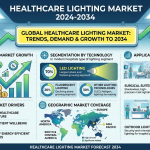
The Healthcare Lighting Market Size is expected to increase from US$10.42 billion in 2025 to US$17.94 billion by 2034, registering a CAGR of 6.22% during 2026–2034. The addressable opportunity is estimated at US$128.35 billion during 2026–2034. North America, particularly the US, is expected to remain an important region for technology adoption as healthcare providers modernize aging facilities and integrate connected lighting, LED luminaires, automated controls, and patient-centric illumination into new and renovated healthcare infrastructure.
Download Sample PDF: https://www.theinsightpartners.com/sample/TIPTE100001332
US Healthcare Infrastructure Drives Demand for Advanced Lighting
The US healthcare sector represents a major opportunity for healthcare lighting manufacturers because of the country's extensive hospital infrastructure and continued investment in healthcare facilities. Healthcare properties are also highly energy intensive. According to ENERGY STAR, US hospitals and healthcare facilities account for approximately 9% of energy consumption in US commercial buildings while representing about 4% of commercial floorspace. ENERGY STAR further notes that typical hospitals can potentially save as much as 30% of energy through efficiency improvements and best practices.
These energy considerations are encouraging hospitals and healthcare networks to replace older fluorescent and other conventional systems with LED-based alternatives. LED technology can provide lower energy consumption, longer service life, reduced maintenance requirements, and improved controllability, making it particularly attractive for facilities that operate continuously. The US National Institutes of Health has also highlighted the potential of LED lighting in healthcare facilities to reduce energy and maintenance requirements while improving visual quality.
LED Upgrades and Hospital Modernization as Key Drivers
One of the strongest drivers across North America is the modernization of existing healthcare buildings. Many hospitals and medical facilities are upgrading lighting systems as part of broader renovation programs involving electrical infrastructure, patient rooms, operating suites, laboratories, and common areas.
Lighting upgrades can provide healthcare operators with an opportunity to improve illumination while controlling long-term operating expenses. In large hospital campuses, even incremental improvements in lighting efficiency can translate into meaningful energy savings because luminaires operate for extended periods. The replacement of legacy systems with LED fixtures, occupancy sensors, dimming systems, and daylight-responsive controls is therefore becoming an increasingly important component of facility modernization.
Smart Lighting Adoption Expands Across US Healthcare Facilities
The integration of connected technologies is another important growth driver in North America. Healthcare organizations are increasingly evaluating lighting systems that can integrate sensors, controls, software, and building-management platforms.
Connected lighting enables facility managers to control illumination according to occupancy, time of day, activity, and specific room requirements. Signify, for example, highlights connected healthcare lighting solutions that combine luminaires, controls, sensors, data, and software to support energy optimization and facility management.
This trend is particularly relevant to large US hospital networks, where centralized monitoring and automated control can help manage lighting across multiple buildings. Smart lighting can also support broader digital-building initiatives, creating opportunities for suppliers that combine lighting hardware with IoT-enabled controls and software.
Patient-Centric Lighting Creates New Opportunities
Healthcare lighting in North America is also shifting from basic illumination toward patient- and caregiver-centered solutions. Hospitals increasingly recognize that lighting quality can influence comfort, visibility, staff performance, and the overall healthcare environment.
Patient rooms, intensive care units, examination rooms, operating rooms, and nursing stations have different lighting requirements. Modern solutions can incorporate adjustable brightness, color temperature, high color rendering, and application-specific optical performance. Signify's healthcare portfolio, for instance, addresses applications including ICUs, NICUs, operating rooms, patient rooms, examination rooms, and nurse stations.
Human-centric and tunable lighting technologies are consequently expected to gain traction as US healthcare organizations place greater emphasis on patient experience and caregiver effectiveness.
Specialized Clinical Applications Support Regional Growth
Healthcare facilities require lighting products capable of meeting demanding clinical and environmental requirements. Surgical environments require precise and high-quality illumination, while laboratories and cleanrooms require solutions designed for specialized operating conditions. Patient rooms and recovery spaces have different requirements related to comfort and flexibility.
Manufacturers are therefore developing healthcare-specific luminaires with advanced optical performance, dimming capabilities, multiple color temperatures, high color rendering, and compatibility with connected control systems. Acuity Brands, for example, offers healthcare-oriented LED solutions designed for applications including patient rooms, laboratories, cleanrooms, and surgical suites, with multiple color-temperature and control options.
North America Competitive Landscape
North America has a strong presence of established lighting manufacturers and technology providers. Leading companies associated with the regional healthcare and hospital lighting landscape include Signify Holding, Acuity Inc., Cree Lighting, Eaton Corporation, Current Lighting, Hubbell Incorporated, Drägerwerk, Stryker Corporation, Zumtobel Group, and Trilux.
The US is particularly important for connected lighting and commercial LED technologies. Signify maintains a broad North American portfolio of LED luminaires, connected lighting systems, controls, and IoT platforms, while Acuity has healthcare-specific products and connected control technologies serving North American facilities.
Future Outlook for North America and the US
The outlook for the North American healthcare lighting sector remains positive as hospitals continue to prioritize energy efficiency, infrastructure modernization, smart-building integration, and patient-centered design. The US is expected to remain a major adoption center because of its large healthcare infrastructure, ongoing facility upgrades, and growing interest in connected building technologies.
Over the coming years, demand is likely to move beyond conventional LED replacement toward integrated solutions combining luminaires, sensors, automated controls, IoT connectivity, energy monitoring, and software. Healthcare providers may increasingly evaluate lighting investments based on total lifecycle costs, operational efficiency, patient experience, and sustainability performance.
With the overall Healthcare Lighting Market projected to reach US$17.94 billion by 2034, the North American opportunity is supported by the continuing transformation of healthcare facilities. Manufacturers capable of delivering energy-efficient, connected, clinically suitable, and patient-centric lighting solutions are positioned to benefit from this long-term shift.
About The Insight Partners
The Insight Partners is a globally recognized market research and consulting firm providing reliable and actionable insights across technology, healthcare, semiconductor, energy, industrial, and other major sectors. Its research helps organizations understand industry trends, evaluate emerging opportunities, and make informed strategic decisions.
Contact Us
The Insight Partners
Email: sales@theinsightpartners.com
Phone: +1-646-491-9876
Website: https://www.theinsightpartners.com
Related Reports -
Submarine Fiber Cable Market Demand, Share & Growth by 2034
Aircraft Wiring Harness Market Dynamics and Trends by 2030
SCADA Oil and Gas Market Size, Trends & Growth by 2034