

Remote sensing infrastructure is becoming increasingly important across North America as industries, utilities, environmental agencies, and infrastructure operators require continuous data from geographically isolated locations. From weather stations and wildfire monitoring to oil and gas assets and wind power facilities, many sensing installations operate far from conventional electricity infrastructure. Reliable autonomous power is therefore becoming an important component of remote monitoring deployments across the United States and Canada.
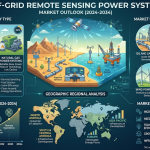
The global Off-grid Remote Sensing Power Systems Market Size was valued at US$617.29 million in 2025 and is projected to reach US$1,768.42 million by 2034, expanding at a CAGR of 12.41% from 2026 to 2034. The addressable market is estimated at US$10,432.43 million during 2026–2034. North America, including the US, Canada, and Mexico, is specifically covered in the regional analysis, with the US identified as a key country market.
Download Sample PDF: https://www.theinsightpartners.com/sample/TIPRE00021467
US Remote Monitoring Infrastructure Drives Demand
The US represents an important growth environment because remote sensing is widely used across geographically dispersed infrastructure. Remote automatic weather stations, for example, are deployed across remote areas of the country and use solar power to collect measurements such as wind speed, precipitation, temperature, humidity, solar radiation, and fuel moisture. The National Interagency Fire Center reports approximately 2,800 Remote Automatic Weather Stations across the US, Puerto Rico, Guam, and the US Virgin Islands.
This extensive deployment demonstrates the practical need for autonomous power technologies that can support sensing equipment where grid access is limited or unavailable. For operators, reliable power is particularly important because interruptions can affect the continuity of environmental, weather, and infrastructure data.
Renewable Energy Is a Major Growth Driver
The increasing use of solar energy is one of the central drivers for off-grid remote sensing power systems in North America. Solar installations can generate electricity directly at remote sensing locations, reducing dependence on utility connections and frequent fuel deliveries. This is especially relevant for weather monitoring, environmental sensing, industrial telemetry, and remote infrastructure.
The US Department of Energy has also emphasized the importance of sensing and communications technologies for improving visibility across energy infrastructure. Greater deployment of distributed energy resources requires more monitoring across different parts of the electricity system, creating opportunities for sensing technologies and associated autonomous power infrastructure.
For remote industrial sites, solar-powered systems can be combined with batteries, controllers, and other power-management technologies to maintain operations during periods of limited sunlight. This hybrid approach supports greater energy resilience and enables equipment to function continuously in challenging environments.
Oil and Gas Applications Support US Adoption
Oil and gas operations are another significant driver across the US. Production sites, pipelines, wellheads, and related infrastructure are frequently located in remote areas where conventional grid connections may be impractical. Remote sensing systems can support telemetry, equipment monitoring, process automation, and safety-related functions.
US-based projects are also demonstrating the use of autonomous solar-powered technologies at remote oil and gas sites. The US Department of Energy has supported projects involving solar-powered systems designed for remote oil and gas operations without grid power, including technologies for monitoring and mitigating methane emissions.
These applications create demand for dependable power systems capable of supporting sensors and communications equipment over extended periods. The combination of remote operations, environmental monitoring requirements, and the need for operational visibility is expected to remain an important demand factor in the US.
Weather and Environmental Monitoring Create New Opportunities
North America's diverse geography creates substantial requirements for environmental and weather monitoring. Remote sensing equipment can be deployed in forests, mountain regions, rural areas, energy sites, and other locations where grid infrastructure is unavailable.
Wildfire monitoring is particularly relevant in the US because remote weather stations provide information used for fire-related decision-making. Solar-powered remote stations demonstrate how autonomous energy systems can support long-term sensing operations without conventional electrical infrastructure.
Beyond weather monitoring, autonomous sensing can support environmental studies, agriculture, infrastructure management, and industrial operations. As organizations seek more granular and continuous data, demand for compact power systems capable of supporting distributed sensor networks is expected to increase.
Technology Innovation Strengthens the Regional Opportunity
Innovation in batteries, solar modules, fuel cells, power electronics, and remote monitoring is improving the capabilities of off-grid systems. Modern installations can integrate energy generation, storage, power conditioning, and communications within compact configurations.
Artificial intelligence and remote analytics are also creating opportunities for more intelligent sensing infrastructure. AI-enabled monitoring can help operators identify changes in environmental or equipment conditions and support more proactive maintenance. The Insight Partners identifies AI-driven analytics, solar-powered remote sensing, and sustainable energy solutions among the future trends influencing the industry.
For North American operators, these capabilities can be particularly valuable when servicing remote installations is expensive or time-consuming. Improved remote diagnostics and power monitoring can reduce unnecessary site visits while supporting system availability.
Key Players
The competitive landscape includes companies developing and supplying power systems, fuel-cell technologies, solar solutions, and integrated equipment for remote applications. Key companies profiled by The Insight Partners include Acumentrics, ENERGY SOLUTIONS (UK) Ltd., Ensol Systems, HES Infra Pvt Ltd., SFC Energy AG, Solar Energy Company, Timber Line Electric and Control Corp., Tycon Systems Inc., UPS Systems plc., and Victron Energy B.V.
In North America, competition is shaped by demand for rugged systems capable of operating under variable weather conditions and in geographically isolated industrial environments. Product development is increasingly focused on reliability, energy efficiency, storage capacity, remote monitoring, and integration with renewable power sources.
Future Outlook
The North American outlook for off-grid remote sensing power systems is closely linked to the continued expansion of remote monitoring infrastructure. In the US, demand can be supported by applications across weather monitoring, oil and gas, wind power, environmental sensing, and distributed infrastructure.
Solar-powered systems are expected to remain an important technology because they can provide locally generated electricity for remote sensors. Battery storage, fuel cells, intelligent power management, and connected monitoring technologies can complement solar generation and help maintain reliable operations.
As remote sensing networks become more connected and data-intensive, power systems will increasingly need to support not only sensors but also communication and edge-processing equipment. This evolution can create opportunities for integrated autonomous power platforms across North America through 2034.
About The Insight Partners
The Insight Partners is a globally recognized market research and consulting firm providing reliable and actionable insights to help organizations make informed business decisions. Its research combines industry expertise, proprietary analysis, company information, government publications, industry databases, and expert perspectives.
Contact Us
The Insight Partners
Email: sales@theinsightpartners.com
Phone: +1-646-491-9876
Website: https://www.theinsightpartners.com
Related Reports -
Submarine Fiber Cable Market Demand, Share & Growth by 2034
Aircraft Wiring Harness Market Dynamics and Trends by 2030
SCADA Oil and Gas Market Size, Trends & Growth by 2034