

Most failed heat tracing projects are not caused by a bad cable. They are caused by a cable specified for the wrong job. Buyers who compare quotations on price per metre alone usually end up replacing the system within a few seasons, or paying to repair the damage it failed to prevent. Before you request a quotation for heat trace cable, confirm six specifications. They take twenty minutes to verify, and they decide whether the installation protects your pipeline during a cold snap or merely looks correct on paper.
1. Minimum Ambient Temperature, Not Average Winter Weather
State the coldest temperature the system must survive, not the average winter temperature for the region. A cable sized for minus ten degrees Celsius will not hold a pipe above freezing during a minus thirty degree spell, however much insulation is added afterwards. Design margin belongs inside the heat-loss calculation, never in the buyer's hope.
2. Pipe or Surface Material
Steel, stainless steel, copper, PVC, PP-R and composite pipe tolerate very different surface temperatures. Plastic pipe deforms when a high-wattage cable is wrapped around it. Confirm the maximum allowable surface temperature of the pipe before selecting wattage, and never assume a cable approved for metal pipe is safe on plastic.
3. Wattage per Metre and Total Circuit Length
Heat loss depends on pipe diameter, insulation thickness, medium temperature and ambient temperature. Long circuits also lose voltage along the run, so a design that performs at twenty metres may underperform at one hundred metres. Ask the manufacturer to run the heat-loss calculation instead of estimating watts per metre from a rule of thumb.
4. Self-Regulating or Constant Wattage
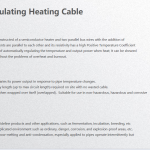
Self-regulating heat trace cable adjusts its output to the surrounding temperature, can be crossed over itself and tolerates less precise installation. Constant-wattage cable delivers a fixed output per metre and suits processes where temperature must be held precisely. The choice follows the application and the risk profile, not the price list.
5. Insulation and Control Strategy
Cable without insulation wastes most of the heat it produces, and insulation without a thermostat wastes most of the electricity the cable consumes. Budget for both from the start. Pipe insulation must be dry and continuous, and outdoor systems should use a moisture or snow sensor so the cable runs only when it is genuinely needed.
6. Certification and Documentation
Ask for certificate files, not a verbal description of them. For European Union sales the baseline is CE and ROHS. For Russia and much of the CIS region it is EAC. For explosive atmospheres it is ATEX. A supplier that cannot produce documents on request will not be able to help when an inspector, insurer or customs officer asks for the same paperwork two years later.
What a Complete Quotation Should Contain
A quotation that lists only cable and price is an incomplete quotation, and it will be followed by additional invoices. A proper offer states the calculated heat loss for each circuit, the selected cable type and wattage, the total circuit length including allowances for valves, flanges and supports, the insulation specification, the termination and junction accessories, the control device and sensor, the certification set for the destination market, and the commissioning procedure. Ask every supplier for the same list and compare the responses line by line rather than page by page.
When the Project Is Indoors Instead
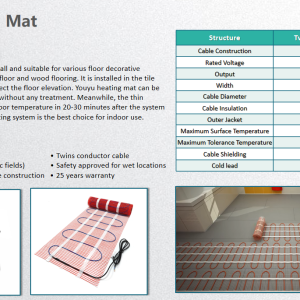
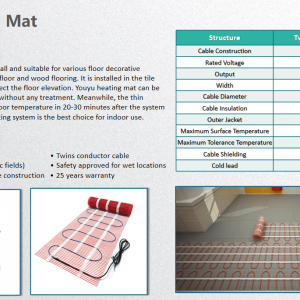
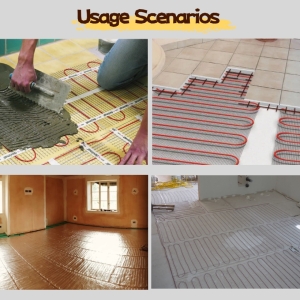
If the requirement is indoor comfort rather than pipe protection, the product changes completely. electric heating mats for floors are pre-wired mesh mats that lay flat beneath tile, stone or laminate and warm the room from the floor upward. They install far faster than loose floor heating cable, need no maintenance access, and pair naturally with a programmable thermostat so bathrooms and bedrooms are warm when they are used and idle when they are not.
How to Compare Suppliers Objectively
Shortlist suppliers on four points: certification depth, engineering support, customisation range and after-sales reach. A Floor heating manufacturer that also engineers industrial trace heating can size indoor and outdoor systems from the same heat-loss method, which keeps specifications consistent across a whole project and prevents the common situation where one supplier blames the other.
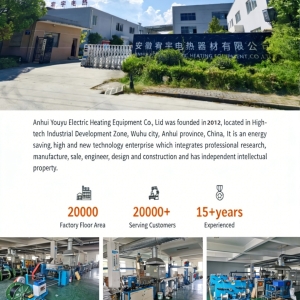
Anhui Youyu Electric Heating Equipment Co., Ltd, founded in 2012 in Wuhu, Anhui Province, China, is an energy-saving high-tech enterprise integrating research, manufacture, sale, engineering, design and construction, with independent intellectual property. Its product range is covered by EAC, CE, ROHS, ATEX, ISO9001, ISO14001 and OHSAS18001 certification. The company places clients first through a strict quality control system and considerate after-sales service, and it welcomes long-term partnerships with buyers at home and abroad.
Frequently Asked Questions
Can I cut heat trace cable to length on site? Only parallel constant-wattage cable that the manufacturer explicitly rates for field cutting. Self-regulating cable should be ordered in finished lengths, because cutting damages its conductive core and creates a leakage risk.
How long should a trace heating system last? With correct installation, dry insulation and sensible control, reputable systems operate for fifteen to twenty-five years. Premature failures usually trace back to mechanical damage, moisture in the insulation or continuous operation without a thermostat.
Is a thermostat really necessary? It is the highest-return accessory available. Without it the cable draws full power whenever it is switched on, including mild nights when nothing is at risk of freezing.
How much spare cable should I order? Add allowance for valves, flanges, supports and the connection to the power supply rather than ordering the bare pipe length. A practical starting point is ten to fifteen percent above the measured pipe run for fittings, confirmed afterwards against the heat-loss calculation.
Why the Lowest Price per Metre Usually Loses
Two quotations can look identical on the first page and differ completely on the fourth. Cheaper offers frequently reduce jacket thickness, omit the termination kits, substitute a fixed thermostat for a programmable one, or supply cable without the certification the destination market requires. Each of those savings reappears later as a service call, a customs delay or a failed inspection. The number that matters is total cost of ownership across the design life of the system, not the invoice value at the moment of purchase.
What to Do Next
Write the six specifications down, send them to two or three manufacturers, and compare the technical responses rather than the headline price. A trace heating system is a twenty-year decision, and the cheapest quotation is rarely the least expensive one once repair, replacement and downtime are counted.https://www.chinayouyu.com