

Air Conditioning System Market Report: Key Highlights
-
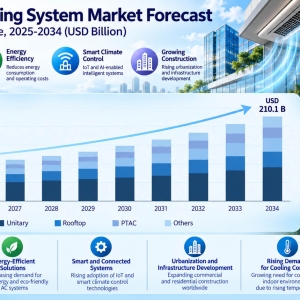
Market Size & Growth: The global air conditioning system market was valued at USD 131.1 Billion in 2025, reached USD 141.0 Billion in 2026, and is projected to touch USD 210.1 Billion by 2034, registering a CAGR of 5.11% during 2026–2034, according to IMARC Group.
-
Regional Leadership: Asia Pacific represents the largest regional market with a share exceeding 60.8% in 2025, supported by rapid urbanization, rising temperatures, and a growing middle-class population across China and India.
-
By Product Type: The market is segmented into unitary, rooftop, PTAC, and other systems, with unitary systems forming the largest segment at around 41.0% share in 2025.
-
By Distribution Channel: The market is divided into specialty stores, supermarkets and hypermarkets, online, and other channels, with specialty stores leading distribution in 2025.
-
By Technology: The market is segmented into inverter and non-inverter technologies, with inverter systems holding the largest share at around 67.5% in 2025.
-
By End Use: The market is divided into residential, commercial, and industrial end uses, with the commercial segment holding the largest share at around 42.0% in 2025.
-
Key Market Drivers: Rising global temperatures and climate change, rapid urbanization and construction activity, and growing demand for energy-efficient and eco-friendly cooling systems.
-
Key Market Trends: Expanding adoption of inverter technology and low-GWP refrigerants, growing integration of IoT-enabled smart thermostats, and rising demand for air purification features bundled with HVAC systems.
-
Key Market Challenges: High upfront costs of energy-efficient systems, engineering complexity in retrofitting older buildings, and regulatory pressure around refrigerant emissions.
-
Key Players: Leading players in the global air conditioning system market include Carrier Global Corporation, Daikin Industries Ltd., Electrolux AB, Haier Group Corporation, Johnson Controls-Hitachi Air Conditioning India Ltd., Lennox International Inc., LG Electronics Inc., Mitsubishi Electric Corporation, Panasonic Corporation, Samsung Electronics Co. Ltd., Trane Technologies plc, Voltas Limited, Whirlpool Of India, and others.
What Is Driving Air Conditioning System Market Growth in 2026?
Rising Global Temperatures and Climate Change
Sustained increases in global average temperatures, intensified by more frequent heatwaves, are pushing households, businesses, and governments to prioritize reliable cooling infrastructure. Regions such as South Asia and the Middle East are seeing summer temperatures repeatedly breach historic records, turning air conditioning from a comfort feature into an essential fixture. This dynamic is reinforcing sustained investment in both residential and commercial cooling installations across established and emerging markets alike.
Increasing Demand for Energy-Efficient Cooling Systems
Rising electricity costs and tightening environmental regulations are accelerating the shift toward energy-efficient air conditioning units. Inverter-based systems, which adjust compressor speed to match cooling demand rather than cycling on and off, are gaining ground over conventional fixed-speed units. Manufacturers are responding with smart, connected products that let users manage energy consumption directly, while government-backed efficiency programs in several countries are further encouraging the replacement of older, less efficient equipment.
Rapid Urbanization and Infrastructure Development
Expanding residential and commercial construction activity, particularly across fast-growing cities in Asia Pacific, the Middle East, and Latin America, is a central driver of new air conditioning installations. As populations shift toward urban centers and disposable incomes rise, demand for climate-controlled living and working spaces continues to climb, supporting steady growth in both new-build and retrofit cooling demand.
Connect for Detailed Segmentation Analysis – Speak to an Analyst: https://www.imarcgroup.com/request?type=report&id=1911&flag=C
Air Conditioning System Market Segmentation Analysis:
By Product Type
-
Unitary
-
Rooftop
-
PTAC
-
Others
Unitary systems account for the largest share of the market at around 41.0% in 2025, reflecting their versatility across both residential single-room and multi-zone commercial applications. Their quiet operation, relatively simple installation, and energy efficiency make them a preferred choice for small to medium-sized offices, retail spaces, restaurants, and homes. Continued growth in residential construction and the expansion of food and hospitality chains worldwide are expected to keep this segment at the center of demand through 2034.
By Distribution Channel
-
Specialty Stores
-
Supermarkets and Hypermarkets
-
Online
-
Others
Specialty stores lead distribution in 2025, owing to their focus on home appliances and HVAC products and the knowledgeable staff who guide consumers through system selection, installation support, and product demonstrations. The showroom experience these stores provide remains valuable for a major household purchase such as an air conditioning system.
By Technology
-
Inverter
-
Non-inverter
Inverter technology leads the market with around 67.5% share in 2025, as variable-speed compressors that adjust output to cooling load rather than cycling on and off deliver substantial energy savings over conventional systems. Manufacturers continue to introduce new inverter product lines with advanced features such as multi-mode cooling, improved condenser materials, and stabilizer-free operation, reinforcing the segment’s lead.
By End Use
-
Residential
-
Commercial
-
Industrial
Commercial end use leads the market with around 42.0% share in 2025, spanning offices, retail stores, hotels, restaurants, educational institutions, and healthcare facilities. The steady expansion of commercial real estate, combined with growing attention to indoor air quality regulations, is expected to keep this segment on a path of moderate, sustained growth.
By Region
-
Asia Pacific (China, Japan, India, South Korea, Australia, Indonesia, Others)
-
Europe (Germany, France, United Kingdom, Italy, Spain, Russia, Others)
-
North America (United States, Canada)
-
Latin America (Brazil, Mexico, Others)
-
Middle East and Africa
Asia Pacific holds the largest regional share at over 60.8% in 2025, led by rapid urbanization, rising temperatures, and an expanding middle class with growing disposable incomes in China and India. Europe is expanding on the back of warmer summers and tightening F-Gas refrigerant regulations, while North America continues to see steady replacement demand tied to energy-efficiency standards and climate-driven cooling needs.
Key Regional Insight: Asia Pacific’s Strategic Position
Asia Pacific’s leadership in the global air conditioning system market is anchored in the scale of residential and commercial construction across China and India, rising temperatures that are turning cooling into a necessity rather than a luxury, and expanding middle-class incomes that are putting air conditioning within reach of more households. Government programs such as India’s National Cooling Action Plan and China’s incentives for energy-efficient appliances are further shaping demand toward sustainable cooling solutions. Continued urbanization, rising construction activity, and sustained heat exposure are expected to keep Asia Pacific at the center of global demand through 2034.
Competitive Landscape in the Air Conditioning System Industry
The competitive landscape of the global air conditioning system market is shaped by active participation from established appliance manufacturers and HVAC specialists competing on energy efficiency, sustainability, and smart-connectivity features. Companies are investing in research and development to deliver variable refrigerant flow systems, IoT-enabled smart controls, and low-GWP refrigerants, while pursuing strategic partnerships, acquisitions, and regional manufacturing expansions to strengthen market presence. A growing focus on after-sales service, localized production, and energy-efficient product lines is emerging as a key differentiator among market leaders as they respond to tightening environmental regulations and shifting consumer preferences.
Key Air Conditioning System Market Players Include:
-
Carrier Global Corporation
-
Daikin Industries, Ltd.
-
Electrolux AB
-
Haier Group Corporation
-
Johnson Controls-Hitachi Air Conditioning India Ltd.
-
Lennox International Inc.
-
LG Electronics Inc.
-
Mitsubishi Electric Corporation
-
Panasonic Corporation
-
Samsung Electronics Co. Ltd.
-
Trane Technologies plc
-
Voltas Limited
-
Whirlpool Of India
Market Drivers, Challenges & Opportunities:
Major Market Drivers:
-
Rising Global Temperatures: Climate change and more frequent heatwaves are expanding the pool of households and businesses that view air conditioning as essential rather than optional.
-
Rapid Urbanization: Growing residential and commercial construction, especially across Asia Pacific and the Middle East, is sustaining steady demand for new cooling installations.
-
Energy Efficiency Momentum: Government efficiency standards and rising electricity costs are accelerating the shift toward inverter-based and other energy-efficient systems.
Key Challenges:
-
High Upfront Costs: Advanced inverter and smart-enabled systems carry higher purchase prices, which can slow adoption in price-sensitive and emerging markets.
-
Refrigerant Regulations: Tightening environmental rules on hydrofluorocarbons are requiring manufacturers to redesign products around new, often costlier, refrigerants.
Emerging Opportunities:
-
Smart and Connected Cooling: Growing adoption of IoT-enabled thermostats and app-based controls is creating new avenues for value-added, connected air conditioning products.
-
Low-GWP Refrigerant Systems: Rising regulatory pressure is opening demand for next-generation systems built around environmentally friendly refrigerants such as R32 and R290.
-
Emerging Market Expansion: Rising incomes and construction activity across Latin America, the Middle East, and parts of Africa are creating new growth opportunities beyond the dominant Asia Pacific market.
Air Conditioning System Market FAQs
1. What is the current size of the air conditioning system market?
The air conditioning system market reached USD 141.0 Billion in 2026, up from USD 131.1 Billion in 2025, and is expected to grow at a CAGR of 5.11% through the forecast period to 2034, reaching USD 210.1 Billion by 2034.
2. What is driving the growth of the air conditioning system market?
The market is driven by rising global temperatures and climate change, rapid urbanization and construction activity, and growing demand for energy-efficient and eco-friendly cooling systems.
3. Which region dominates the air conditioning system market?
Asia Pacific leads the market with a share exceeding 60.8% in 2025, supported by rapid urbanization, rising temperatures, and a growing middle-class population across China and India.
4. Which segment holds the largest share in the air conditioning system market?
Unitary systems lead the market by product type with around 41.0% share, while commercial end use leads with around 42.0% share, reflecting the central role of offices, retail spaces, and hospitality venues in overall demand.
5. What are the key trends in the air conditioning system market?
Key trends include growing adoption of inverter technology and low-GWP refrigerants, expanding integration of IoT-enabled smart thermostats, and rising demand for air-purification features bundled with HVAC systems.
Conclusion: Air Conditioning System Market Outlook to 2034
The global air conditioning system market is positioned for steady growth through 2034, underpinned by rising global temperatures, ongoing urbanization, and the sustained shift toward energy-efficient cooling solutions. While high upfront costs and tightening refrigerant regulations present ongoing challenges, manufacturers continue to prioritize inverter technology, smart connectivity, and environmentally friendly refrigerants.
With Asia Pacific maintaining its position as the leading regional market and Europe, North America, Latin America, and the Middle East and Africa offering further growth avenues, the outlook through 2034 remains positive. Companies that invest in energy-efficient product lines, smart cooling technology, and low-GWP refrigerant systems will be best placed to capture value as demand for reliable, sustainable cooling continues to rise worldwide.
About the Author:
IMARC Group is a leading global market research company providing data-driven insights and expert consulting services to businesses seeking to achieve their strategic objectives. With a multi-disciplinary team of industry experts, IMARC delivers thorough, reliable market intelligence across sectors including Energy and Mining, Construction and Manufacturing, Electronics and Semiconductors, Chemicals and Materials, and more.
Media & Sales Contact:
IMARC Group
United States: +1-201-971-6302
India: +91-120-433-0800
United Kingdom: +44-753-714-6104