

Direct Air Carbon Capture Technology Market to Reach USD 9.10 Billion by 2032, Driven by Decarbonization and Technology Innovation
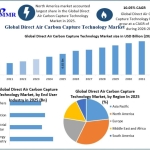
The Direct Air Carbon Capture Technology Market is entering a period of accelerated development as governments, energy companies, technology providers, and investors seek scalable solutions for removing carbon dioxide directly from the atmosphere. The market was valued at USD 4.65 billion in 2025 and is expected to grow at a CAGR of 10.05% from 2025 to 2032, reaching nearly USD 9.10 billion by 2032. Growth is supported by climate-mitigation requirements, corporate net-zero commitments, government incentives, technological improvements, and demand for captured CO2 for permanent storage and low-carbon products.
Market Estimation, Growth Drivers and Opportunities
Direct Air Capture (DAC) removes atmospheric CO2 independently of an emission source. Government grants, tax incentives, carbon-management programs, and corporate sustainability commitments are improving the investment environment. Research is focused on increasing capture efficiency, lowering energy consumption, extending sorbent or filter life, and reducing capital and operating costs.
Opportunities are emerging from next-generation capture materials, modular plant designs, permanent geological storage, and utilization of captured CO2 in fuels, concrete, and industrial products. Electro-swing adsorption, zeolite-based systems, passive DAC, and improved sorbents are expanding the technology pipeline. High energy requirements and capital intensity remain challenges, but efficiency gains and larger projects could improve economics as deployment scales.
Get Your Free Sample Report Link : https://www.maximizemarketresearch.com/request-sample/80672/
United States Market Trends and Investment
The United States remained a DAC development center in 2025. The U.S. Department of Energy’s Regional DAC Hubs program provides up to USD 1.8 billion for commercial DAC facilities and supporting infrastructure. 1PointFive’s STRATOS project in Texas is designed for up to 500,000 tonnes of CO2 removal annually. JPMorganChase agreed to purchase 50,000 metric tons of DAC-enabled carbon removal credits over ten years, while United Airlines’ Sustainable Flight Fund invested in Heirloom and secured rights to purchase up to 500,000 tons of carbon removal. These developments connect DAC with aviation, fuels, and storage.
Market Segmentation: Largest Segments
By operating temperature, High-Temperature DAC dominated the market in 2025 and is expected to retain the largest share through the forecast period. Higher-temperature processes can enhance reaction kinetics and support efficient CO2 separation.
By end-use industry, the Energy Industry dominated the market in 2025 and is expected to maintain the largest share. DAC can complement energy-sector decarbonization and support carbon management linked with power generation and low-carbon fuel production.
Competitive Analysis
The MMR report identifies Carbon Clean Solutions, Climeworks, Carbon Engineering, Global Thermostat, in its competitive landscape. Individual company market-share percentages are not disclosed in the publicly accessible report summary, so specific shares are not assigned.
Climeworks raised USD 162 million in additional equity in 2025, taking cumulative funding above USD 1 billion. Its development work targets higher energy efficiency, throughput, longer filter life, and Generation 3 structured sorbent technology for larger-scale deployment.
Carbon Engineering, whose technology is deployed by 1PointFive, supports large-scale liquid-sorbent DAC. STRATOS is designed around 500,000 tonnes of annual capacity, providing a pathway toward industrial deployment.
Heirloom continued commercial development of limestone-based DAC in 2025. United Airlines invested through its Sustainable Flight Fund, while Development Bank of Japan and Chiyoda later invested to support scaling.
Carbon Clean expanded carbon-capture innovation in 2025 through its Global Innovation Centre in India and commercial testing of CycloneCC C1. Its rotating packed-bed design and proprietary solvent technology reflect the industry’s movement toward compact and efficient capture systems.
Global Thermostat remains a notable U.S. DAC developer, focusing on solid-sorbent atmospheric carbon capture. Advances in sorbents, regeneration, process integration, and lower-energy operation remain important to improving DAC economics.
Regional Analysis
United States: Federal DAC Hub funding, tax incentives, project development, and a carbon-removal ecosystem support market expansion. Projects in Texas and Louisiana benefit from industrial infrastructure and access to geological storage.
United Kingdom: The UK’s carbon-capture and storage strategy and DAC research, including electro-swing adsorption development, create opportunities for commercialization.
Germany: Germany’s industrial base, climate targets, and interest in carbon-management technologies provide opportunities for DAC engineering, equipment, and carbon-removal services.
France: France’s decarbonization agenda and industrial transition create opportunities for carbon-removal technologies that address difficult residual emissions.
Japan: Japan’s carbon-capture roadmap targets 6–12 million tonnes of CO2 captured annually by 2032, including DAC. Japanese institutions also invested in Heirloom in 2025, highlighting interest in DAC for carbon removal and low-carbon fuels.
China: China’s industrial base and carbon-neutrality objectives create opportunities for DAC, although commercial deployment depends on costs, energy availability, and infrastructure.
Key Players
Carbon Clean Solutions; Climeworks; Carbon Engineering; Global Thermostat; CarbonCure Technologies; Skytree; Soletair Power; Green Energy Storage; LanzaTech.
Why This Market Matters Now
DAC is moving from pilot development toward projects. Government support, corporate carbon-removal procurement, improved materials, modular engineering, and expanding storage infrastructure are strengthening deployment pathways. The projected increase from USD 4.65 billion in 2025 to USD 9.10 billion by 2032 highlights the commercial importance of atmospheric carbon removal. Progress in reducing energy use, improving capture materials, securing storage, and lowering project costs will shape the market’s next phase.
Explore More Related Reports:
Agricultural Films Market https://www.maximizemarketresearch.com/market-report/agricultural-films-market-global/42869/
Global Carbon thermoplastic market https://www.maximizemarketresearch.com/market-report/global-carbon-thermoplastic-market/82551/
About Maximize Market Research
Maximize Market Research Pvt. Ltd. (MMR) is a global market research and consulting company providing data-focused business insights. The firm serves healthcare, pharmaceuticals, technology, automotive, electronics, chemicals, personal care, and consumer goods. Through market forecasts, competitive analysis, consulting, and industry impact assessments, MMR helps organizations understand markets, identify opportunities, and make informed decisions.
Contact Us
2nd Floor, Navale IT Park Phase 3
Pune Banglore Highway, Narhe
Pune, Maharashtra 411041, India
+91 9607365656
sales@maximizemarketresearch.com