
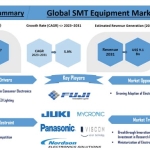


The global electronics manufacturing services (EMS) industry, semiconductor packaging sector, and hardware infrastructure supply chains are undergoing an intensive structural alignment centered on component miniaturization, advanced high-mix automated production, and total factory connectivity. Surface Mount Technology (SMT) equipment—the highly complex collection of screen printers, high-speed placement machines (pick-and-place), reflow ovens, and intelligent inspection systems—forms the critical manufacturing backbone required to assemble modern printed circuit boards (PCBs). Driven by an unprecedented surge in automotive electrification, localized semiconductor fabrication initiatives, and the rapid deployment of next-generation AI hardware, the industry is tracing a highly lucrative path. Valued at USD 6.6 Billion in 2025, the global SMT Equipment Market is expanding at a robust CAGR of 7.48% from 2026 to 2036, positioned to reach a market valuation of USD 14.6 Billion by the end of 2036.
The market is navigating a defining technology transition characterized by "The Convergence of SMT Lines with Back-End Semiconductor Packaging and the Transition from Closed Hardware Systems to Unified Open-API Factory Software." Historically, standard SMT placement operated on a separate floor from semiconductor back-end assembly, dealing primarily with passive chips and standard integrated circuits (ICs). However, as modern consumer electronics and high-performance computing demand ultra-compact layouts, the industry has turned heavily toward system-in-package (SiP) architectures and heterogeneous integration. This structural shift has forced SMT equipment vendors to re-engineer pick-and-place modules with advanced visual recognition systems capable of placing micro-scale 0201 and 008004 components with sub-micron accuracy. Concurrently, to optimize floor yield, tier-1 manufacturers are displacing siloed machines with fully integrated inline setups utilizing smart communications standard protocols (like IPC-CFX), enabling real-time feedback loops between printing, placement, and reflow operations.
Strategic Growth Drivers: The 7.48% Assembly Surge
The steady upward momentum carrying the market toward USD 14.6 Billion is sustained by automotive electronics diversification, stricter defect regulations, and a sweeping regional wave of factory automation:
- The Massive Influx of Electronic Architectures in Modern Vehicles: The global automotive sector has transitioned rapidly toward electric powertrains, complex Advanced Driver Assistance Systems (ADAS), and connected infotainment units. This shift has radically multiplied the volume of active PCBs required per vehicle. Because automotive electronics demand extreme thermal stability and absolute fail-safe operation, manufacturers are aggressively purchasing high-reliability SMT systems equipped with specialized vacuum reflow ovens to completely eliminate solder joint voiding.
- Tightening Quality Control Standards via High-Velocity Inline Inspection: As electronic architectures become incredibly complex, manual or post-batch testing is no longer viable. Advanced regulatory frameworks across medical, aerospace, and computing sectors are requiring 100% inline inspection traceability. This demand is acting as a primary driver for the rapid adoption of 3D Automated Solder Paste Inspection (SPI) and 3D Automated Optical Inspection (AOI) units directly into live SMT lines.
- The Rapid Integration of Industry 4.0 and Smart Autonomous Factories: Faced with persistent labor shortages and rising operating costs, manufacturing plants are turning to highly automated, software-driven assembly setups. Modern SMT production lines are evolving into closed-loop systems where automated inspection modules instantly communicate alignment corrections back to screen printers and placement tools, preventing defects before they happen and drastically maximizing substrate output.
Engineering Innovation & Smart Architecture: The 2036 Roadmap
Over the forecast period, precision robotics engineering laboratories and manufacturing software suites will prioritize Intelligent Yield Optimization and Dynamic Setup Versatility:
- Deploying Advanced AI-Driven Placement Calibration Systems: To sustain massive hourly placement rates without sacrificing alignment metrics, manufacturers are embedding edge-AI models into pick-and-place equipment. These intelligent software stacks analyze physical camera nozzle data in real-time, instantly adjusting positioning parameters to counteract component variations, warped boards, or slight machine thermal expansions without halting active production.
- Scaling Multi-Track Modular Screen Printing Formats: To eliminate traditional bottlenecks at the initial stage of the assembly line, equipment designers are commercializing dual-lane and multi-track automated stencil printers. By running parallel printing channels simultaneously, these systems allow high-volume electronics facilities to feed multiple fast placement units concurrently, dramatically maximizing overall equipment effectiveness (OEE).
- The Development of Energy-Efficient, Low-Voiding Reflow Technologies: Traditional reflow ovens consume massive amounts of electricity to maintain complex multi-zone thermal profiles. Next-generation reflow equipment utilizes optimized internal convection loops, localized nitrogen curing zones, and smart power management software to slash energy consumption by up to 35% while creating highly stable, oxidize-free solder connections.
Regional Analysis & Market Realignment
Asia-Pacific: The Dominant Global Epicenter for Volume and Advanced EMS
The Asia-Pacific region stands as the undisputed global titan in the SMT equipment market, commanding the largest revenue and shipment share. This dominant presence is structurally rooted in the immense manufacturing networks of China, Japan, Taiwan, South Korea, and rapidly expanding electronics corridors in India and Vietnam. Backed by direct regional component supply chain control and immense national investments in advanced semiconductor and foundry infrastructure, Asia-Pacific remains the primary destination for high-capacity, fully automated SMT assembly lines.
North America: High-Tier Defense Specialization and Localized Onshoring
North America represents a highly specialized, premium market segment driven by intense reshoring efforts and strict geopolitical supply chain policies. In the United States and Canada, defense electronics, aerospace systems, and high-performance medical applications demand extreme quality verification. The region is seeing a significant wave of capital expenditure directed toward high-mix, low-volume SMT setups capable of rapid line reconfigurations, heavily supported by legislative incentives aimed at restoring domestic advanced electronics manufacturing.
Europe: Premium Automotive Mechatronics, Industrial Robotics, and Green Compliance
The European landscape is intensely integrated with the region’s massive automotive and industrial automation sectors, particularly across Germany, France, Italy, and the UK. SMT machine acquisition is heavily guided by strict manufacturing safety laws and comprehensive environmental regulations focusing on energy efficiency and carbon reductions. European EMS providers place a significant premium on high-end, exceptionally precise 3D inspection arrays and flexible, modular pick-and-place machinery tailored to handle heavy power electronics and industrial mechatronic components.
Conclusion: The Era of Interconnected, Autonomous Electronics Assembly
By 2036, the Global SMT Equipment Market will stand as a highly sophisticated, data-rich segment of industrial automation, where precision mechanical placement operates in perfect harmony with edge-AI optimization and unified software ecosystems. Reaching a projected market valuation of USD 14.6 Billion emphasizes that leading electronics brands and contract manufacturers no longer look at SMT lines as separate machine units, but rather as fully synchronized cyber-physical assets vital for maximizing line yield, ensuring complete component traceability, and shortening product launch windows. The industrial engineering firms, precision machinery builders, and inspection technology developers that lead this highly competitive global sector over the coming decade will be those that successfully balance extreme mechanical throughput and sub-micron positioning accuracy with open-architecture, cloud-native smart factory integration, guaranteeing that global electronics assembly can seamlessly scale to power a smarter, hyper-connected digital world.