
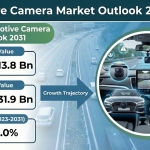


The global automotive manufacturing, digital safety systems, and autonomous mobility infrastructure sectors are experiencing an intensive technological overhaul centered on machine vision expansion, high-definition spatial tracking, and strict regulatory safety mandates. Automotive cameras—the highly engineered optical arrays encompassing forward-looking, side-mirror, interior-cabin, and rear-view enhancement modules—have rapidly evolved from optional convenience features into foundational vehicle safety components. Modern original equipment manufacturers (OEMs) and Tier-1 hardware suppliers rely on these specialized vision modules to capture and translate physical road data into vital actionable inputs for vehicle control computers. Driven by the near-universal adoption of Advanced Driver Assistance Systems (ADAS), escalating buyer awareness, and tightening global crash-test safety evaluation metrics, the industry is tracing an exceptionally sharp growth path. Valued at US$ 13.8 Billion in 2022, the global Automotive Camera Market is expanding at a robust CAGR of 10.0% from 2023 to 2031, positioned to reach a commanding market valuation of US$ 31.9 Billion by the end of 2031.
The sector is currently navigating an industry-wide engineering transformation characterized by "The Transition from Isolated Analog Vision Feeds to Fully Synchronized, Multi-Camera Digital Surround Networks Integrated with Machine Learning Edge Software." Historically, vehicle cameras operated as separate, low-resolution units—most notably as simple back-up cameras displaying standard static parking lines on a center console. Today's automotive architectures, however, leverage centralized high-speed Ethernet backbones to stitch together continuous 360-degree digital surround views. To support Level 2+ and higher autonomous driving capabilities, these multi-camera clusters continuously feed raw, high-frame-rate visual data into AI-driven perception engines. This enables active vehicle platforms to execute automated emergency braking, adaptive lane-keep assistance, and real-time traffic sign recognition simultaneously under highly variable environmental conditions.
Strategic Growth Drivers: The 10.0% Vision Surge
The double-digit compound momentum propelling the market toward US$ 31.9 Billion is sustained by intensifying active safety regulations, high-value premium feature migration, and the expansion of autonomous computing platforms:
- Stricter Global New Car Assessment Program (NCAP) Safety Requirements: Regulatory frameworks worldwide—including Euro NCAP, the US NHTSA, and India's Bharat NCAP—are aggressively updating their vehicle evaluation metrics. To secure top-tier 5-star safety ratings, automakers are compelled to implement automated pedestrian detection, blind-spot monitoring, and forward-collision avoidance setups, making high-performance forward-view cameras standard equipment.
- The Rapid Proliferation of Democratic 360-Degree Surround Setups: Once a feature exclusive to ultra-luxury flagship sedans, multi-camera surround systems have become a dominant consumer trend across mass-market sport utility vehicles (SUVs) and compact crossovers. By nesting compact corner-view and side-mirror cameras into the vehicle's structural layout, OEMs are dramatically lowering low-speed collision damage risks and enhancing parking safety.
- The Rise of Level 3 and Level 4 Autonomous Transit Implementation: As commercial robotaxis, autonomous delivery shuttles, and highway pilot software packages expand globally, the requirement for absolute sensory redundancy multiplies. Autonomous systems rely heavily on multi-focal stereo camera rigs and high-resolution optical arrays to deliver precise depth perception and color contrast mapping that complements radar and LiDAR arrays.
Optical Engineering & Hardware Innovations: The 2031 Roadmap
Over the forecast period, automotive vision laboratories and semiconductor image sensor facilities will prioritize High Dynamic Range (HDR) Stability and Intelligent In-Cabin Contextual Tracking:
- Deploying 8-Megapixel (MP) High-Definition Image Sensors: Standard legacy 1.2 MP automotive cameras struggle with long-distance object clarity. Next-generation front-sensing camera systems are transitioning rapidly to high-reliability 8 MP sensors, allowing vehicle safety computers to identify minor road hazards, debris, or lane shifts from distances greater than 250 meters away at highway velocities.
- Advanced LED Flicker Mitigation (LFM) and Ultra-High Dynamic Range: Modern traffic infrastructure and vehicle lighting rely almost exclusively on high-frequency pulsed LEDs, which often appear to "blink" or flash on standard digital camera feeds, confusing computer vision algorithms. Advanced optical modules are embedding hardware-level LFM and broad HDR processing to capture clear, uncorrupted visual data when moving instantly from pitch-black tunnels into bright, direct sunlight.
- The Commercial Scalability of Interior-View Cabin Monitoring Systems (OMS): Spurred by European safety mandates designed to curb driver fatigue and distracted texting, automakers are embedding interior infrared cameras into steering columns and rearview mirror assemblies. These compact units utilize machine learning models to track rapid driver blinking patterns, eye-gaze directions, and head orientations, triggering automated audible safety alerts if distraction thresholds are breached.
Regional Analysis & Market Realignment
Asia-Pacific: The Dominant Global Epicenter for Scale, Volume, and ADAS Influx
The Asia-Pacific region holds the primary geographic and volumetric anchor in the global automotive camera market. This commanding position is anchored directly by immense vehicle assembly volumes, rising purchasing power, and a high preference for advanced tech features among younger car buyers. Mainland China stands out as the largest single market driver in the region, accounting for nearly half of the Asia-Pacific market share. This footprint is backed by an explosive domestic electric vehicle (EV) sector that routinely implements multi-camera AI computing architectures as a core product differentiator.
North America: High-Value Revenue Scale Driven by Premium SUV and Truck Dominance
North America represents a highly lucrative, high-margin market segment characterized by a massive consumer preference for large passenger trucks, commercial delivery vans, and premium SUVs. In the United States and Canada, the demand for sophisticated rear-view enhancement, multi-angle trailer-towing cameras, and advanced hands-free highway driving aids is exceptionally high. The regional landscape strongly rewards Tier-1 technology suppliers capable of delivering highly durable, all-weather optical hardware that resists extreme temperature variations.
Europe: Flawless Regulatory Alignment and Pioneer of Cabin Monitoring Tech
The European automotive camera market moves forward under the world's most aggressive active safety and occupant protection guidelines. Across major manufacturing hubs like Germany, France, Italy, and the UK, the adoption of advanced forward-view and interior-view cameras is heavily accelerated by strict General Safety Regulation (GSR) mandates. European automakers place an extreme premium on optical purity, compact mechanical integration, and high-performance infrared sensing systems optimized for dark night-driving scenarios.
Conclusion: The Vision-Led Future of Automotive Safety Orchestration
By 2031, the Global Automotive Camera Market will operate as a cornerstone segment of the broader intelligent transportation economy, where traditional optical lens manufacturing converges completely with advanced digital processing and deep neural networks. Reaching a projected market valuation of US$ 31.9 Billion emphasizes that the global automotive industry has definitively graduated past passive crash mitigation into an era of proactive, vision-led accident avoidance. The optical engineers, semiconductor fabrication groups, and computer vision developers that lead this highly competitive global marketplace over the coming decade will be those that successfully balance extreme hardware ruggedization to withstand decades of harsh road vibration and weathering with sub-millisecond data processing velocities, ensuring that modern smart vehicles can safely navigate, interpret, and protect the world they move through.