
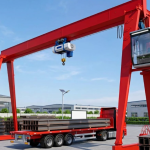






Outdoor material handling presents a range of challenges for industrial facilities, steel yards, and logistics centers. Heavy materials and oversized components need to be lifted and transported safely, while operators must keep infrastructure investment, maintenance costs, and site utilization under control. Building an indoor crane bay can require extensive structural work, and mobile cranes may not be the most economical option for repetitive lifting tasks.
A high-quality single girder gantry crane offers an alternative for businesses that need reliable lifting equipment in outdoor working areas. Running on ground-level rails, this type of crane can handle regular material movement without requiring the same elevated runway structures used by conventional overhead cranes.
Goldcrane manufactures single girder gantry crane systems for industrial material-handling applications, with configurations designed around lifting requirements, site layouts, and operating conditions. Understanding the main selection factors can help buyers identify equipment that fits their daily operations and long-term investment plans.
1. Control Installation Costs While Meeting Lifting Requirements
Infrastructure costs are an important consideration when expanding an outdoor stockyard or production area. An overhead bridge crane typically requires elevated runway beams, supporting columns, and suitable building foundations. These requirements may increase project costs, particularly at facilities that were not originally designed for overhead lifting equipment.
A single girder gantry crane travels along ground-level rails, reducing the need for dedicated elevated crane-support structures. This arrangement can be useful for open yards, loading areas, and industrial sites where constructing a permanent crane bay is impractical.
Goldcrane's single girder gantry crane designs use box-girder structures made from Q235B or Q355B steel, according to the supplied product information. The range covers rated lifting capacities of approximately 1–20 tons and spans of up to 45.5 meters, depending on the configuration.
Structural design also affects the crane's deadweight and wheel loads. Optimizing these factors can help reduce demands on the rail foundation, although the actual foundation requirements must be determined from the crane's wheel loads, ground conditions, rail arrangement, and applicable design standards.
For buyers, the key is to match the rated lifting capacity and span to the materials being handled, rather than selecting equipment based on maximum capacity alone. The working duty, lifting frequency, and expected service life should also be considered during specification.
2. Improve Lifting Precision and Workplace Safety
In a busy steel yard or logistics facility, crane performance involves more than moving a load from one location to another. Operators need predictable motion, controlled stopping, and suitable safety features to reduce the risk of load damage and workplace accidents.
When evaluating a custom single girder gantry crane with an electric wire rope hoist, buyers should review the following features.
-
Variable frequency drives: VFD control can provide smoother acceleration and deceleration, helping reduce sudden movements during lifting and traveling. The supplied Goldcrane specifications list traveling speeds of approximately 8–35 m/min, depending on the configuration.
-
Reliable braking systems: Appropriately selected brakes help hold loads securely during normal operation and stopping. Buyers should confirm the braking arrangement, inspection requirements, and behavior under the specified operating conditions.
-
Overload protection: Overload limiters can help prevent lifting beyond the crane's rated capacity.
-
Limit switches and collision protection: These devices can help restrict movement at defined travel limits and reduce collision risks where the equipment is configured with suitable protective systems.
-
Operator control options: Wireless remote controls or an operator cab can be selected according to visibility, working conditions, and site layout.
Safety performance depends on the complete system, including correct installation, operator training, inspection, and maintenance. Buyers should request details of the supplied safety devices and confirm which features are included in the proposed configuration.
3. Select a Weatherproof Gantry Crane for Outdoor Use
Outdoor lifting equipment must withstand conditions that can gradually affect structural components, electrical systems, and moving parts. Rain, humidity, dust, and temperature changes can contribute to corrosion, component deterioration, and unplanned maintenance.
For this reason, choosing a weatherproof single girder gantry crane requires attention to both surface protection and electrical enclosure design.
According to the supplied Goldcrane product information, the steel components undergo Sa2.5 shot blasting before receiving multilayer epoxy zinc-rich anti-corrosion coatings. Electrical cabinets and drive motors can be specified with IP55 or IP65 protection, with rain shields where required.
The stated operating temperature range is approximately -20°C to +60°C. Buyers should confirm whether this range applies to the complete proposed crane or to particular components, and whether additional measures are needed for local weather conditions.
When preparing a specification for outdoor service, consider:
-
Corrosion protection suitable for the site's humidity and exposure conditions
-
Electrical enclosure ratings appropriate to dust and water exposure
-
Protection of motors, cables, and control equipment
-
Inspection and maintenance access
-
Any special requirements for coastal environments, chemical exposure, or extreme temperatures
Matching the protection system to the actual operating environment can help reduce avoidable downtime and extend equipment service life.
4. Customize the Crane to Match Your Site Layout
Industrial yards differ in their available space, rail positions, material dimensions, and loading procedures. A standard crane configuration may not provide the most practical solution for every facility.
A custom single girder gantry crane can be designed around the site's operating requirements. For example, an extended cantilever may allow the crane to handle materials beyond the main rail span, where the design and loading conditions permit. Specialized below-the-hook equipment, such as lifting magnets or C-hooks, may also be considered for handling steel products and other specific loads.
The control arrangement is another important decision. Wireless remote control can offer flexibility for ground-level operation, while a cab may be appropriate for certain layouts or operating conditions. The choice should account for the operator's visibility, travel distance, and the need to coordinate with other equipment and personnel.
Before confirming a customized design, buyers should provide accurate site drawings, rail dimensions, required lifting height, load details, and information about any nearby structures or obstacles. These details help the manufacturer assess the proposed configuration and identify potential installation constraints before production begins.
5. What Information Should You Provide to a Single Girder Gantry Crane Manufacturer?
A clear technical inquiry helps manufacturers recommend suitable equipment and prepare a quotation based on the actual project scope. Before contacting a supplier, organize the following information:
| Requirement | Details to prepare |
|---|---|
| Rated lifting capacity | Maximum load weight, including relevant lifting attachments |
| Span | Distance between the crane's supporting rail centerlines |
| Lifting height | Required vertical lifting distance |
| Working duty | Lifting frequency, operating hours, and expected workload |
| Operating environment | Indoor or outdoor use, temperature range, dust, moisture, and corrosion exposure |
| Rail and foundation | Existing rail dimensions, ground conditions, and available site drawings |
| Power supply | Available voltage, frequency, and electrical requirements |
| Control method | Wireless remote, cab, or another suitable arrangement |
| Lifting attachments | Hooks, magnets, C-hooks, or other application-specific devices |
| Project support | Applicable standards, documentation, warranty, delivery schedule, and after-sales service |
The final technical specification should define the required performance and included equipment clearly. For customized projects, review the approved drawings and technical documents before manufacturing begins.
Goldcrane provides configurable single girder gantry crane solutions for different material-handling needs. Supplying complete project information helps the manufacturer evaluate the application and propose a configuration that aligns with the site's operating conditions.
Conclusion
Choosing a high-quality single girder gantry crane requires balancing lifting performance, installation requirements, safety, environmental protection, and long-term maintenance. For outdoor industrial applications, a ground-rail gantry design can be a practical alternative when an elevated overhead crane structure is unsuitable or too costly to install.
Before purchasing, compare the rated capacity, span, lifting height, working duty, control system, protective features, and foundation requirements. A well-defined technical specification makes it easier to evaluate manufacturers and avoid unnecessary changes during installation.
With suitable planning and a configuration matched to the actual workload, businesses can use Goldcrane's single girder gantry crane solutions to support more efficient and reliable outdoor material handling.